
What Is a 2-on-1 and Why Is It Needed?
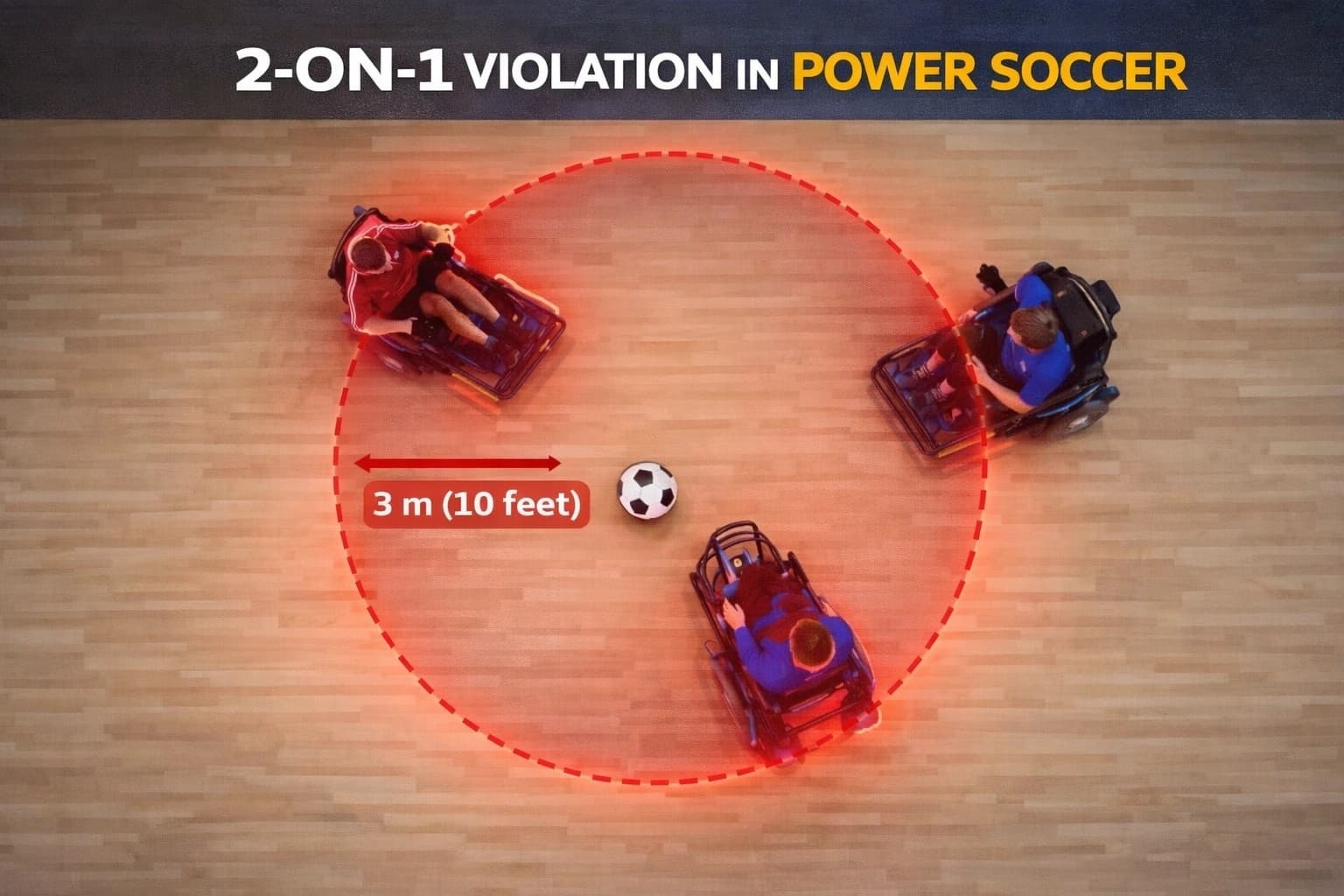
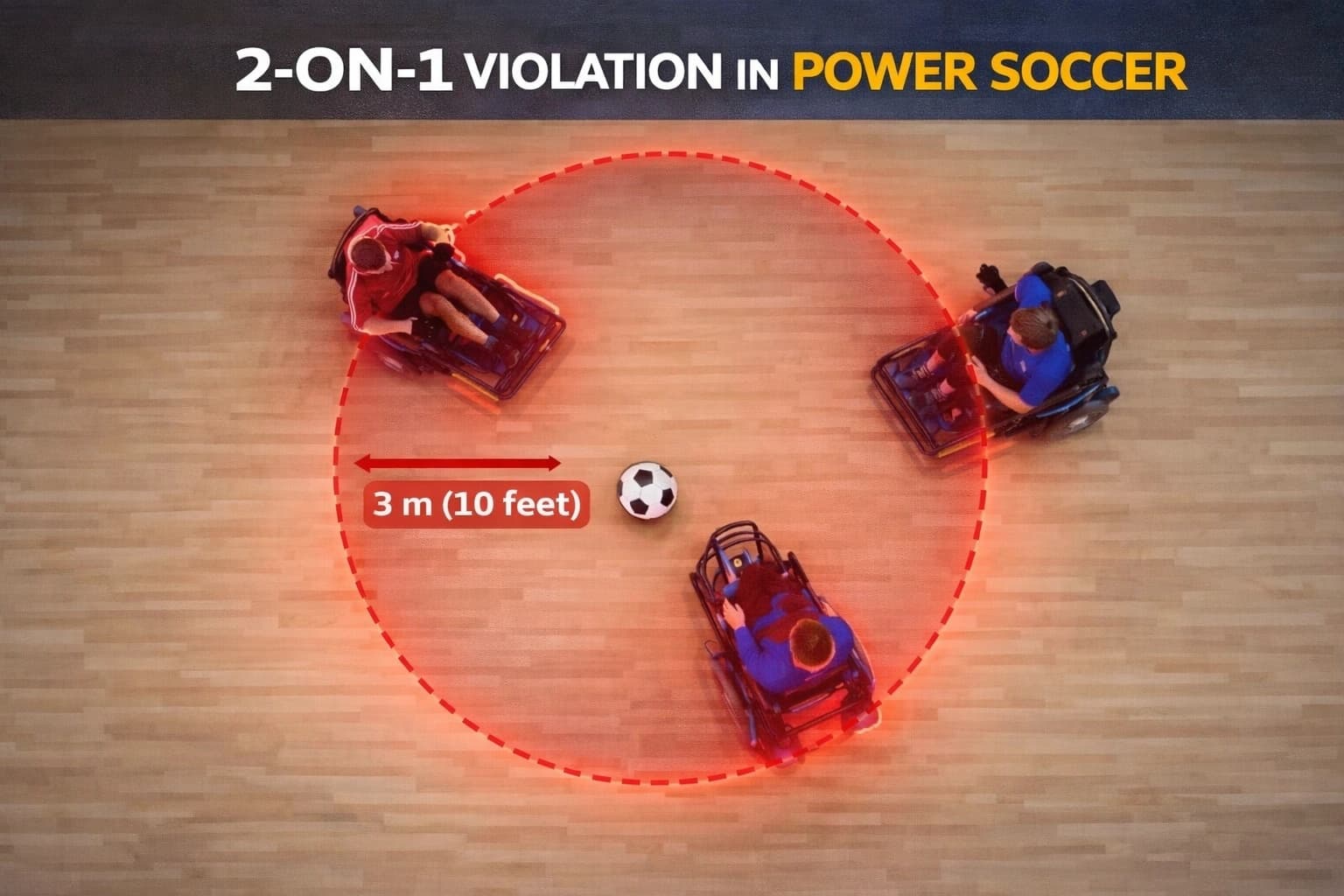
One of the most common infringements in power soccer is the 2-on-1. Understanding what it is, why it exists, and how it happens is essential for players, especially those new to the sport. A 2-on-1 occurs when two teammates and one opponent are all within 3 meters (10 feet) of the ball while it is in play. When this happens, the referee will stop play and award a kick-in to the opposing team.
This rule was introduced to:
- Spread the game out
- Encourage passing and movement
- Reduce congestion around the ball
- Improve safety
- Make power soccer resemble traditional soccer more than rugby
While the rule sounds simple on paper, it can be very difficult for players to visualize and judge distance in real time, especially younger or newer players. Unlike the boundary lines on the court, the 3-meter spacing requirement is invisible, and players must learn to “feel” it through experience.
For most teams, that understanding doesn't fully click until their first tournament, when repeated 2-on-1 calls by referees quickly reinforce how much space is actually required. By the end of that tournament, most players will gain a much better perspective on proper spacing.
Leading Causes of a 2-on-1
Although 2-on-1s can happen to any team, they usually stem from a few common issues. Below are the most frequent causes seen in competitive play:
▸ 1. Chasing the Ball
“Chasing the ball” occurs when a player pursues it without a clear purpose or role. This often pulls a second teammate too close to the ball, resulting in a 2-on-1.
Chasing the Ball:
- Breaks team structure
- Confuses teammates
- Prevents proper rotation
- Increases congestion near the ball
Power soccer is a team sport, and spacing is just as important as ball control.
▸ 2. Miscommunication
Miscommunication is one of the most common causes of 2-on-1 violations, especially during kick-ins and goal kicks.
When defenders fail to communicate:
- Multiple players may attack the ball unnecessarily
- Offensive opportunities are lost
- The opposing team can simply pass the ball, forcing a 2-on-1 call
Good communication allows one player to pressure the ball while others maintain proper spacing and passing lanes.
▸ 3. Not Getting Out Of The Way Fast Enough
This often happens when an offensive role teammate:
- Misjudges where the ball is going
- Fails to reverse quickly after passing
- Loses awareness after a transition
Even a short delay can bring two teammates within the 3-meter zone, triggering a violation. Quick awareness and timely movement away from the ball are critical.
▸ 4. Poor Triangle Structure
A strong triangle structure is the foundation of spacing in power soccer. When two players are positioned too close together—often aligned horizontally rather than triangular—a 2-on-1 is almost inevitable.
If players are spaced just barely over 10 feet apart, even small movements can collapse that spacing. Without excellent communication, the risk of a violation increases dramatically.
▸ 5. Lack of Coaching Education
While uncommon, a failure to clearly explain the 2-on-1 rule can lead to major issues, especially for players new to power soccer or adaptive sports.
Power soccer can be unfamiliar to many athletes, and assuming players “will just figure it out” often results in a rude awakening at tournaments. The best approach is simple:
“Explain the rule early, explain it clearly, and reinforce it often.”
Final Thoughts
2-on-1 violations are part of the learning curve in power soccer. They are not a sign of poor effort, but rather a sign that spacing, communication, and structure still need refinement.
With proper coaching, intentional practice, and tournament experience, teams quickly learn how to manage spacing effectively. Over time, avoiding 2-on-1s becomes second nature—and the game opens up into the fast, strategic, and exciting sport it is meant to be.